
1950 - 1960
“Don’t let anyone look down on you because you are young, but set an example for the believers in speech, in life, in love, in faith and in purity.” 1 Timothy 4:12
One who disclaimed knowledge of the “gentlemen’s agreement” was Ted Dallmann, a retired builder who helped organize Mount Calvary Church, the first Missouri Synod congregation in Phoenix. In later years it came to be known as the Synod’s “Mother Church” in central Arizona. Ted and Helene Dallmann moved to Phoenix from Riverside, Illinois, in 1948. Before the Dallmanns left Illinois, they were advised that the Missouri Synod’s English District planned to start missions in Arizona. They were given a list of Lutherans living in the area and were encouraged to get in touch with them.
In the meantime, a small group of Missouri Synod Lutherans living in Phoenix, mostly unaffiliated with any church, were anxious to have a Missouri Synod church started in the Valley. Dr. Victor Behnken, President of the Southern California District of the Missouri Synod, was contacted regarding procedures for starting a church by Willard and Francis Vanatter, parents of Claude Vanatter, a former Mount Calvary member. Dr. Behnken advised them to contact Reverend Boxdorfer in Yuma where the only Missouri Synod Lutheran church existed in Arizona. The pastor suggested that they run an ad in the paper to ascertain how many people in Phoenix were sincere about starting a church. He also said that if there were enough families interested in starting a Missouri Synod mission, he would come to Phoenix and hold services on Sunday evenings.
In early 1950 an ad ran for two weeks in the local newspaper. The ad resulted in fifteen families coming together to form the nucleus of the church. All families were contacted by Willard and Claude Vanatter, and a report was made to Rev. Boxdorfer who, in the meantime, had accepted a call to California. Dr. Behnken was contacted again and given the same information that had been given Rev. Boxdorfer.
After several weeks Dr. Behnken sent Mr. Vanatter a telegram advising him that the Reverends Streufert and Ted McRee of the English District were at a Tucson hotel in connection with the mission being started there. However, Mr. Vanatter failed to make connection with them.
Shortly after this, the Reverend R. Jesse of the English District started holding services in Tucson. The Vanatter family drove to Tucson to see him. Rev. Jesse suggested they find two or more families not affiliated with any synodical conference in Phoenix who would write to the Mission Board of the English District and ask it to start a mission in Phoenix. His advice was followed. Helene and Ted Dallmann and Vesta and Harold Griffith were contacted to write the letter, and they complied. Permission was finally granted to start a mission church in Phoenix as of July 10, 1950.
78 Attend First Service
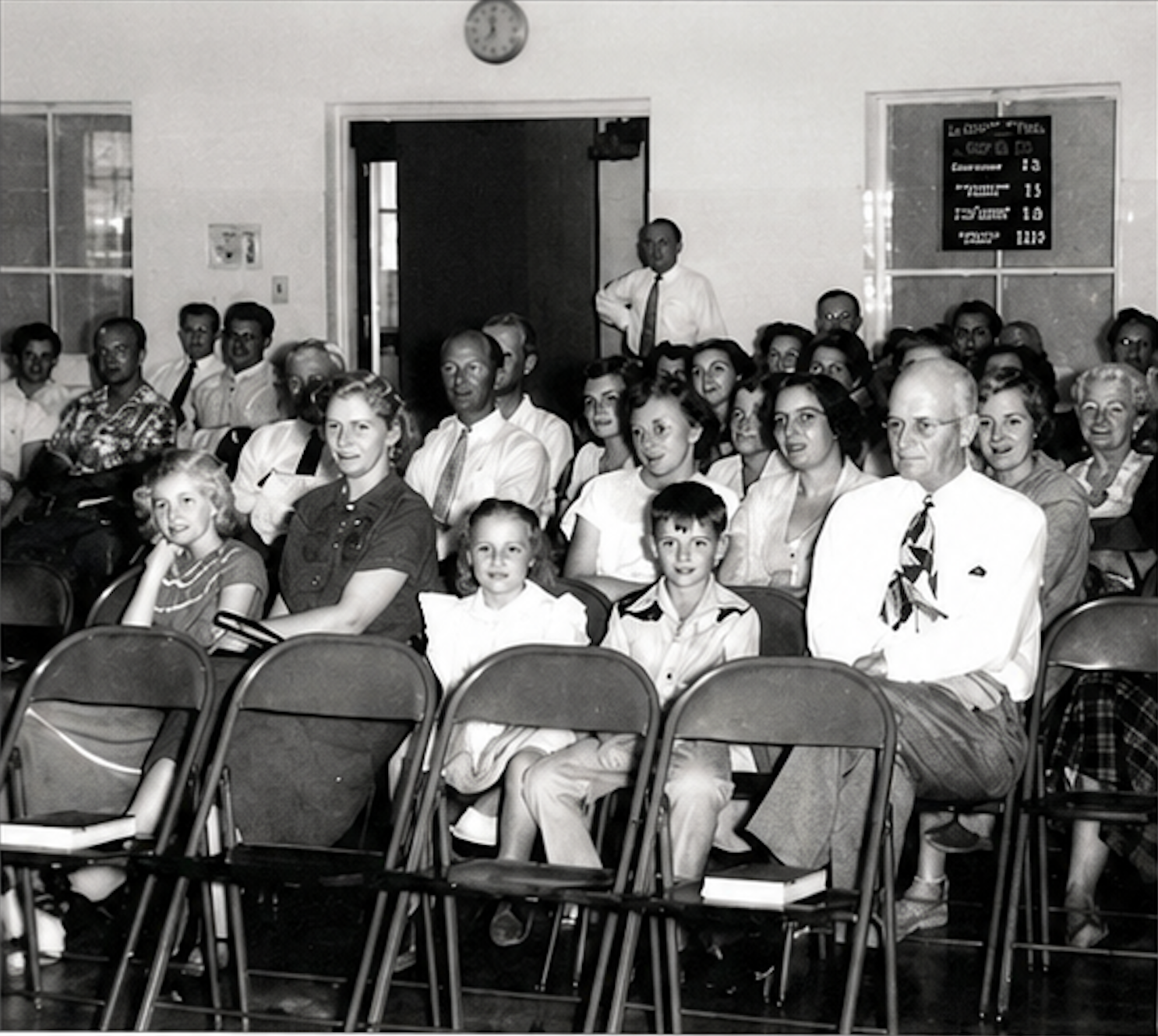
The first service was held in a classroom at Grandview School on July 23, 1950. Seventy-eight people attended.
The first service, attended by 78 people, was held in a classroom at Grandview School, located at 11th Avenue and Camelback Road, on July 23, 1950. In organizing and electing Theodore Dallmann as temporary president and Harold Griffith temporary treasurer at this service, the fervent church founders demonstrated they wanted a quick and sure foundation. The fledgling congregation organized as Mount Calvary Lutheran Church of Phoenix with approximately 79 charter members.
The first Easter service was held in the garden courtyard of Grandview School in 1951. The altar was decorated with palms donated by Sophia and Bernard (Barney) Schler, and Aletha Vanatter made a cross for the altar. This service was sponsored by Ted and Helene Dallmann and Harold and Vesta Griffith. Both services were conducted by the Rev. Emil H. Polster, missionary-at-large, who later accepted the Call to serve as the first congregational pastor. See Chapter Ten for Pastor Polster’s biography.
With obvious foresight, Ted Dallmann led a diligent search of many properties for a proper site to erect the church building. Ten acres of land were purchased for $20,000 at the corner of 7th Avenue and Colter Street, with Rudolph Ewald advancing the first $1,000 as down payment on the present property. Ground was broken in March of 1952 and construction of the parish facility began. The following members were listed as the Building Committee: Chester Norris (Chairman), Willard R. Vanatter, Ed Krafft, Bernard Schler, Walter Hoehn and Walter Haake.
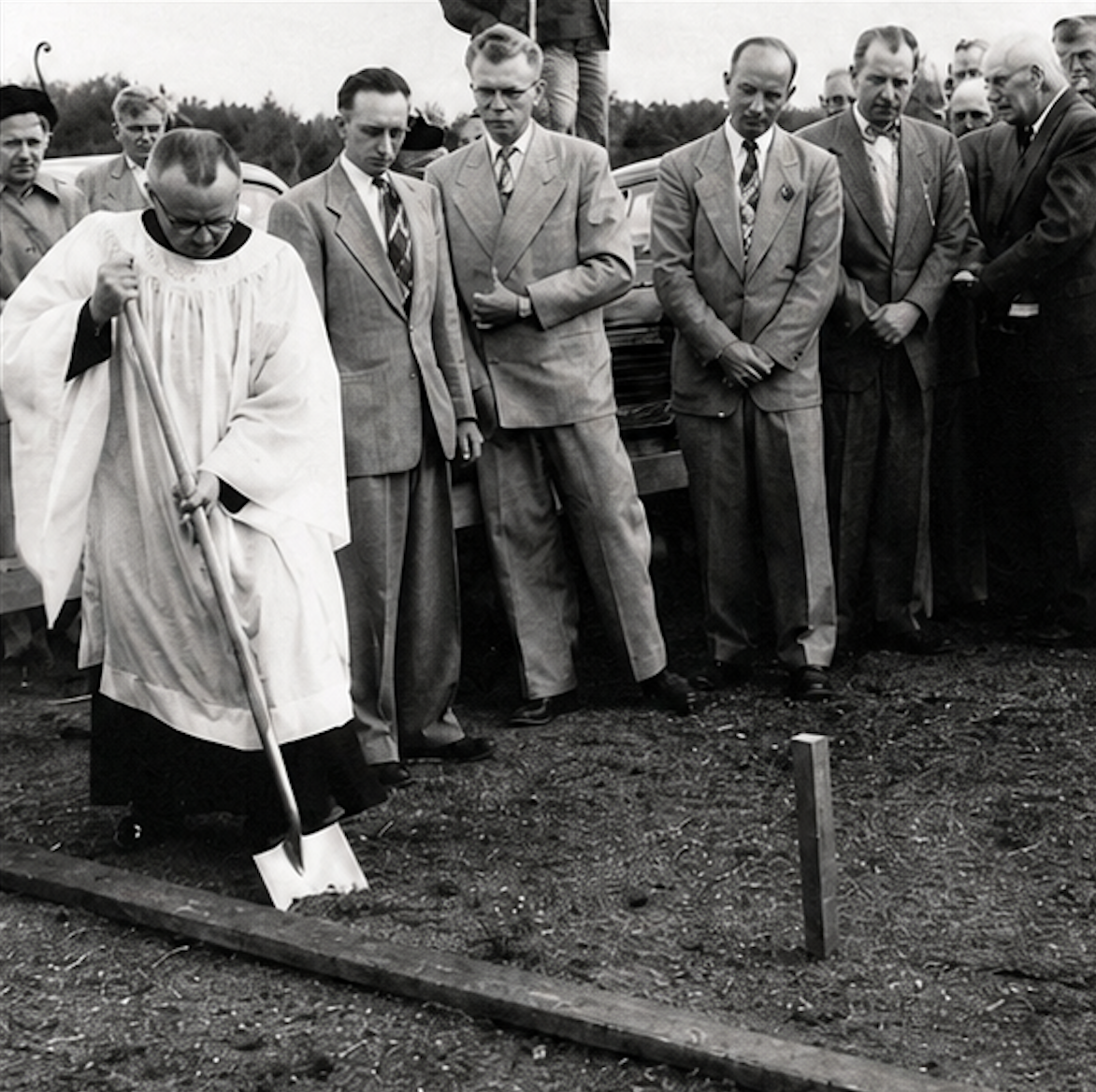
Groundbreaking ceremony took place in March 1952 at 7th Avenue and Colter Street.
The cornerstone-laying service was held on May 11, 1952. When dedication services were held on September 28, 1952, the total membership had increased to 376 members (259 communicants). Participating in the dedication ceremony was the Reverend Harold H. Engelbrecht, who a few years later was installed as Mount Calvary’s second pastor. Information about the construction of the first house of worship may be found in Chapter Seven of this book.
Church Logo is Designed
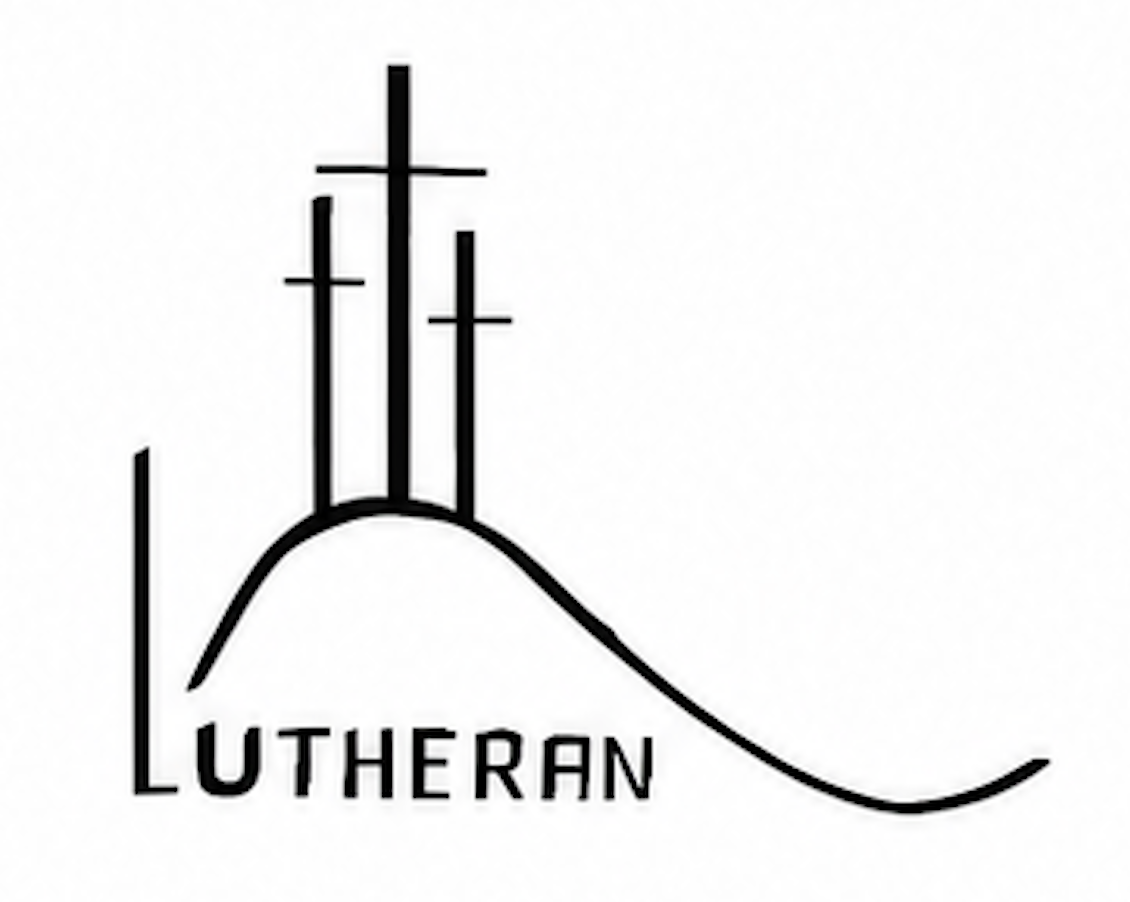
The original church logo that appeared on the front of the church building was designed by Pastor Polster. The curved line was symbolic of Mount Calvary; the center cross represented the Cross of Christ, flanked on either side by crosses representing the penitent and impenitent thieves.
An Artistic Interior
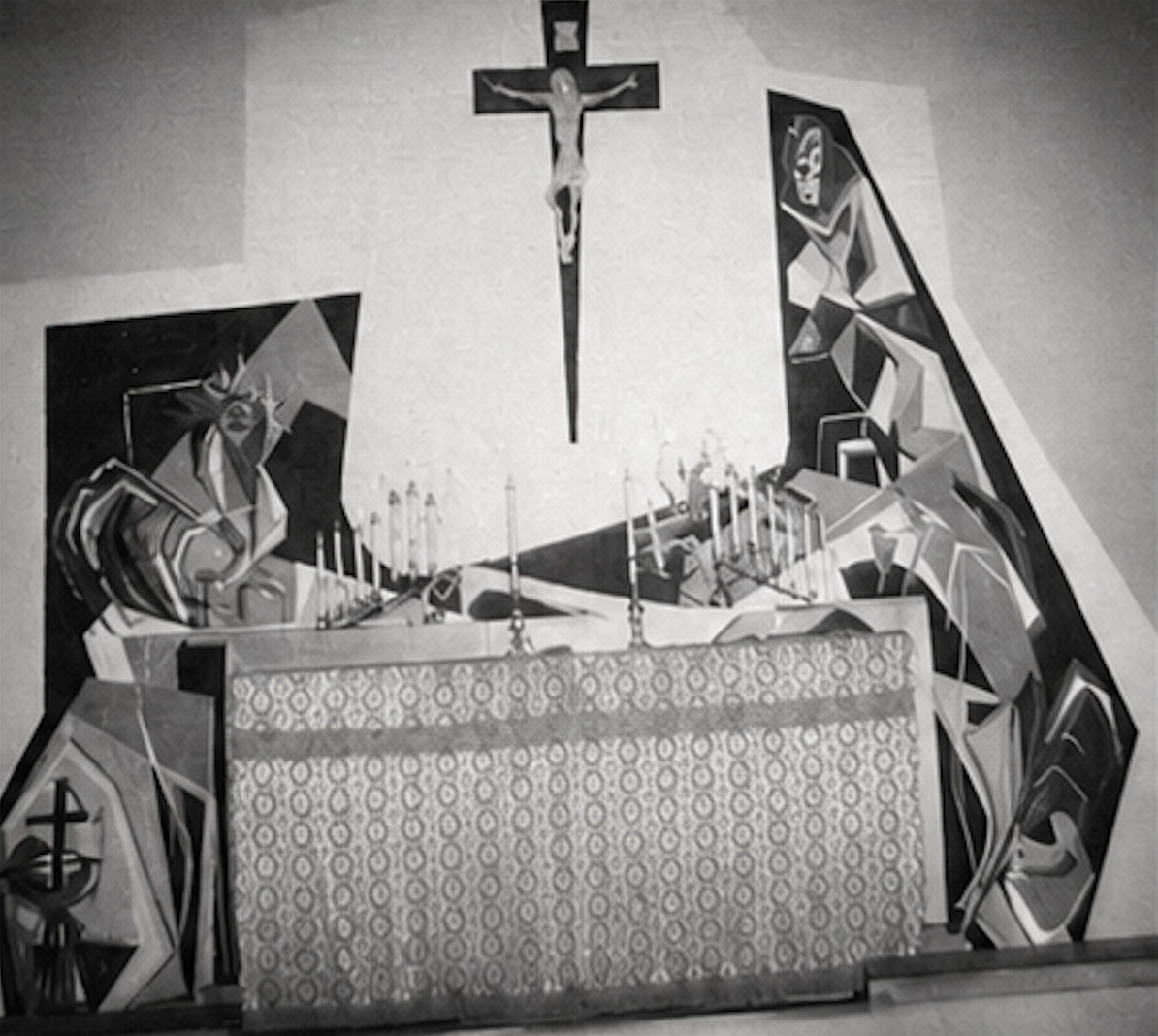
Symbols behind the altar were painted by Virginia Polster, the pastor’s daughter, who interpreted the “Passion of our Lord Jesus Christ” by use of ancient symbols in terms of modern expression. From this artwork the church received the nickname of “The Red Rooster Church.”
Persons seeking an architecturally conventional church were soon to be surprised when they viewed the new Mount Calvary sanctuary from the inside. Vivid shades of chartreuse, red and yellow literally danced on the reredos wall. “Some don’t like it,” reported The Arizona Republic. “But those who first objected were soon defending it,” continued the newspaper in describing the altar painting. Pastor Polster described it as “Phoenix’s first attempt at modern art inside a church structure.”
The symbols used were the chalice and the cross commemorating the institution of Holy Communion; the shield and rope of Judas, who betrayed our Lord to His enemies and subsequently hanged himself with the rope; the cock crowing at the third denial by Peter; the crown of thorns pressed upon our Lord’s head in Pilate’s judgment hall; the nails driven into His hands and feet on the cross atop Mount Calvary; the bowl of sour wine and hyssop reed used by the soldiers when Jesus cried, “I thirst!”; and surmounting all else, the symbols of the bursting pomegranate, denoting our Lord’s resurrection and the hope of everlasting life. All these symbols and the general design of the wall pointed to the cross of Christ, the very center of our hope.
The finely-balanced design, shades of dark green to light, and striking color patterns all led to the focal point—a hand-carved crucifix crafted by Richard Cook, artist and congregational member, who consumed more than a year’s time to complete the cross.
It took Virginia eight months to complete the painting. The church received a nickname, “The Red Rooster Church,” but Pastor Polster remained firm in his conviction that religion is responsible to the arts and science.
The Cross of Calvary
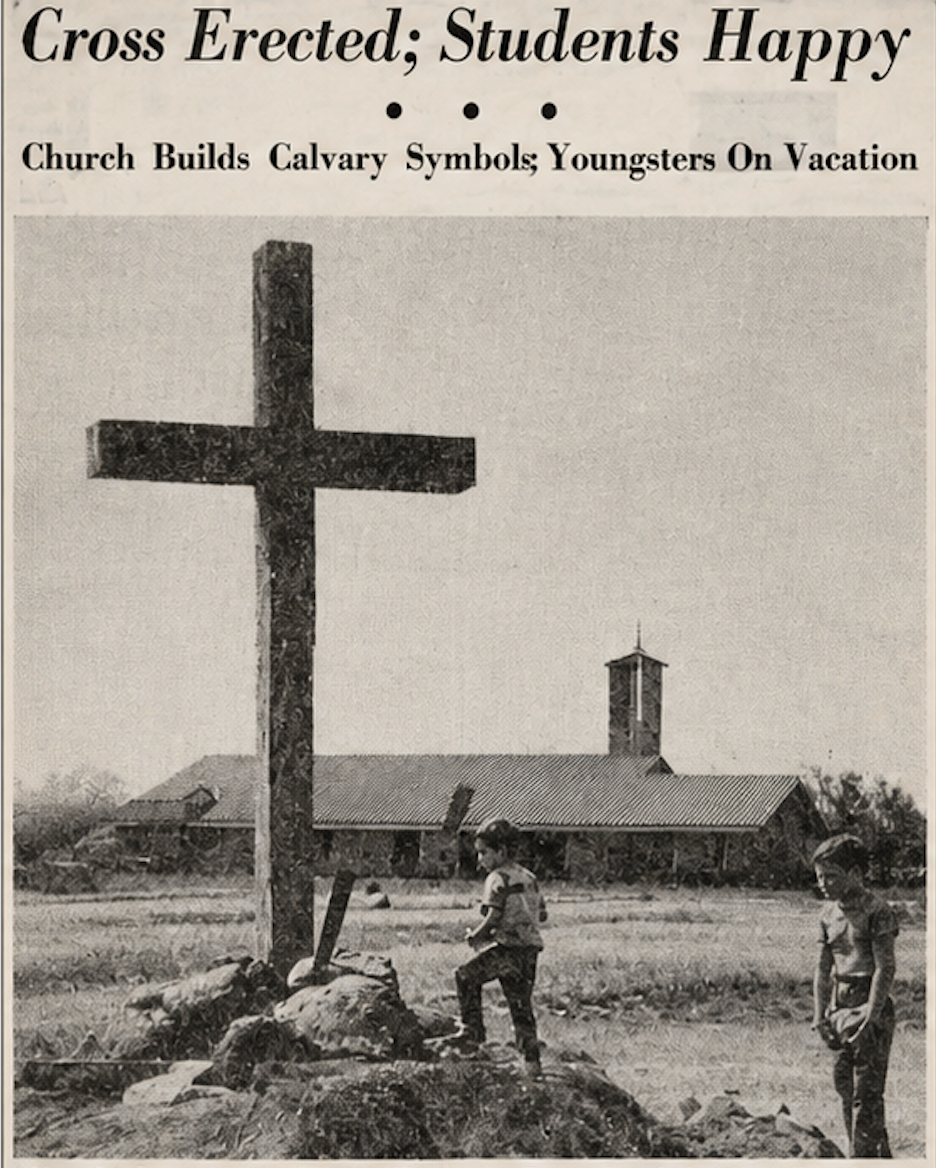
The Cross of Calvary was erected on the corner of 7th Avenue and Colter. On April 10, 1979, the badly-deteriorated cross was replaced by a new one donated by the Heldt Lumber company.
In mid-1953 a “Cross of Calvary” was installed at the corner of 7th Avenue and Colter Street by Fred Abel and his son Kurt. Each Sunday School class presented a tree of its choice to the park area. These trees were planted on Arbor Day in 1953. Ramadas for cookouts were later built. Fred’s wife, Penny, designed a small park in which the cross was the focal point. Rocks were placed around the foot of the cross as part of the landscaping; however, the years took their toll, and on April 10, 1979, the badly-deteriorated cross was replaced with a new one donated by the Heldt Lumber Company and installed by the Board of Trustees.
Vicar Louis Nau
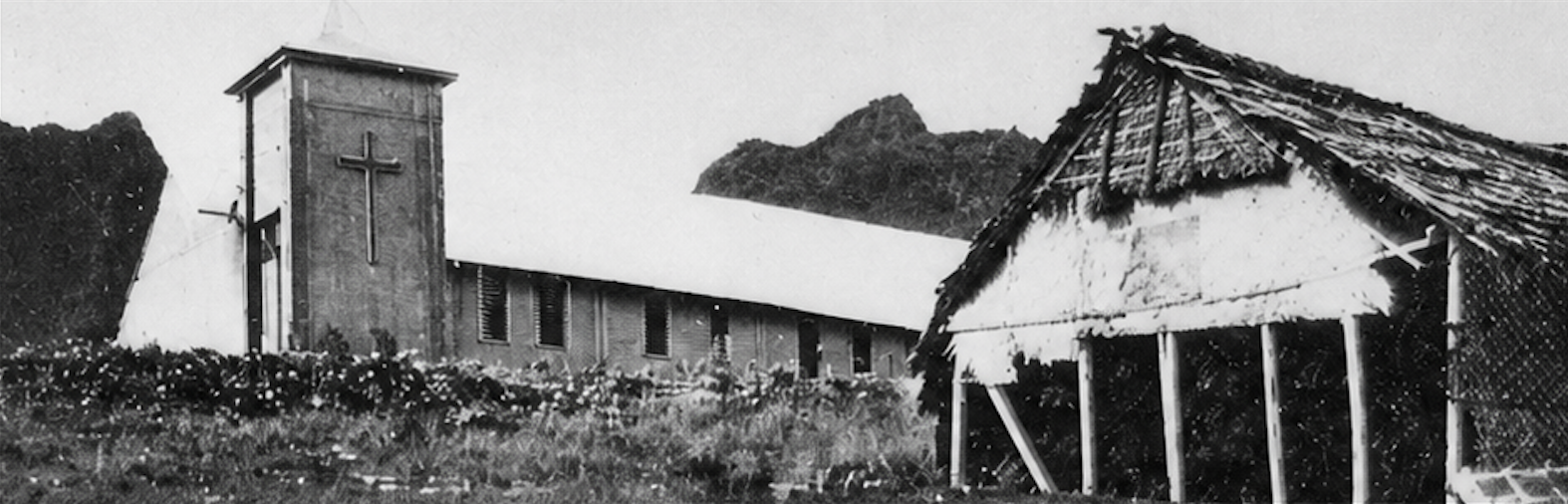
Vicar Nau became a missionary in the Philippines. His church, Mount Calvary at Balakbak, Philippines, was dedicated in May 1955.
A ministerial student from Concordia Seminary in St. Louis, Missouri, Louis Y. Nau was assigned to spend his vicarage year assisting Pastor Polster at Mount Calvary. He served in this capacity until September 1953 when he returned to the Seminary for his final year. He came back to Mount Calvary in 1954 for his ordination into the ministry. His first Call was as a missionary to the mountainous country of north-central Luzon in the Philippines. One of his accomplishments during this assignment was to dedicate the Mount Calvary Chapel in 1955 in Luzon. The same three crosses on the church logo of Mount Calvary in Phoenix appear over the door of Mount Calvary Chapel in Luzon.
Farewell to the Polsters
October 1954 found the congregation joining to bid farewell to its beloved Pastor Polster and Margaret. He had accepted a call as public relations director for the Lutheran Children’s Friends Society of Minnesota. Following his departure, church services were conducted by lay people and visiting pastors—in particular, the Reverends Marcus Lang and William F. Dietz from Tucson.
The Engelbrechts Arrive
This arrangement continued until February 20, 1955, when the Reverend Harold H. Engelbrecht was installed as the second pastor of Mount Calvary Church. See Chapter Ten for Pastor Engelbrecht’s biography.
With the onset of a vigorous building program soon to be implemented in the Valley, a new sign was erected on the property of one of Mount Calvary’s parishioners who resided in Apache Junction. This sign announced the availability of Missouri Synod Lutheran churches in the Phoenix area.
Pastor Engelbrecht readily assumed the building reins relinquished by Pastor Polster. Progress in the building program during his pastorship was incredible. In 1955 there was one building, two small areas of lawn, nine palm trees and a few shrubs. The entire north end of the property was desert and covered with tumbleweeds. The south parking lot was unpaved.
Luther Hall is Built
At the north side of the chapel, a new educational unit, known as Luther Hall, was dedicated September 28, 1957. See Chapter Seven for construction details. The new wing aided an expanding Sunday School with the preschool and kindergarten classes being held there. These classes were under the direction of Ruth Drnjevic, with Betty Komorous and Mildred Isaacs as teachers.
In the fall of 1958 this wing also served as the first day school, which consisted of Kindergarten and Grades One and Two. Arthur Weidner was the first principal and served in that capacity until his departure to enter the ministry in 1964. The Shreckengost twins, Cathy and Carol, were the first students enrolled in the school.
Church is Remodeled
Soon it was back to the drawing board with another building program. This time it was to remodel the original church structure. A detailed description of this process can be found in Chapter Seven under “Remodeling of the Sanctuary.”
As the first decade of Mount Calvary’s existence passed, the facilities were in place to allow God’s people to worship in comfortable surroundings. The congregation was growing and vital. They were ready to share their blessings with the growing population of Phoenix.
—William Mahlke