
1960 - 1970
“They devoted themselves to the apostles’ teaching and to the fellowship, to the breaking of bread and to prayer.” Acts 2:42
In June of 1960, as Vice-President Richard Nixon campaigned against Senator John F. Kennedy, Arizona’s “mother church” in the Lutheran Church-Missouri Synod sent its representative, Bud Harmann, to a different kind of convention—the Synodical Convention in Milwaukee, Wisconsin.
In this era of major change and growth, Mount Calvary was released from the English District of the Synod to join the Southern California District. Thus began an era of change and growth of its own. Starting off with a bang, it teamed with other churches in the Valley to sponsor a city-wide rally featuring Reverend Oswald Hoffmann’s “Crusade,” which began on June 24, 1960, in the Scottsdale Ballpark.
Even as our church looked forward to its future, it also commemorated a significant milestone in its history—its tenth anniversary. Pastor Emil Polster, the first pastor of the congregation, spoke as guest preacher.
‘Daughter’ Churches
Also during the summer of 1960 Robert Orling, a member of Mount Calvary, served as the vicar. Two “daughter” churches were opened, the first of eleven spun off from the “mother church” during this decade of rapid growth. They were St. Paul’s (west Phoenix) and Holy Cross (east Phoenix).
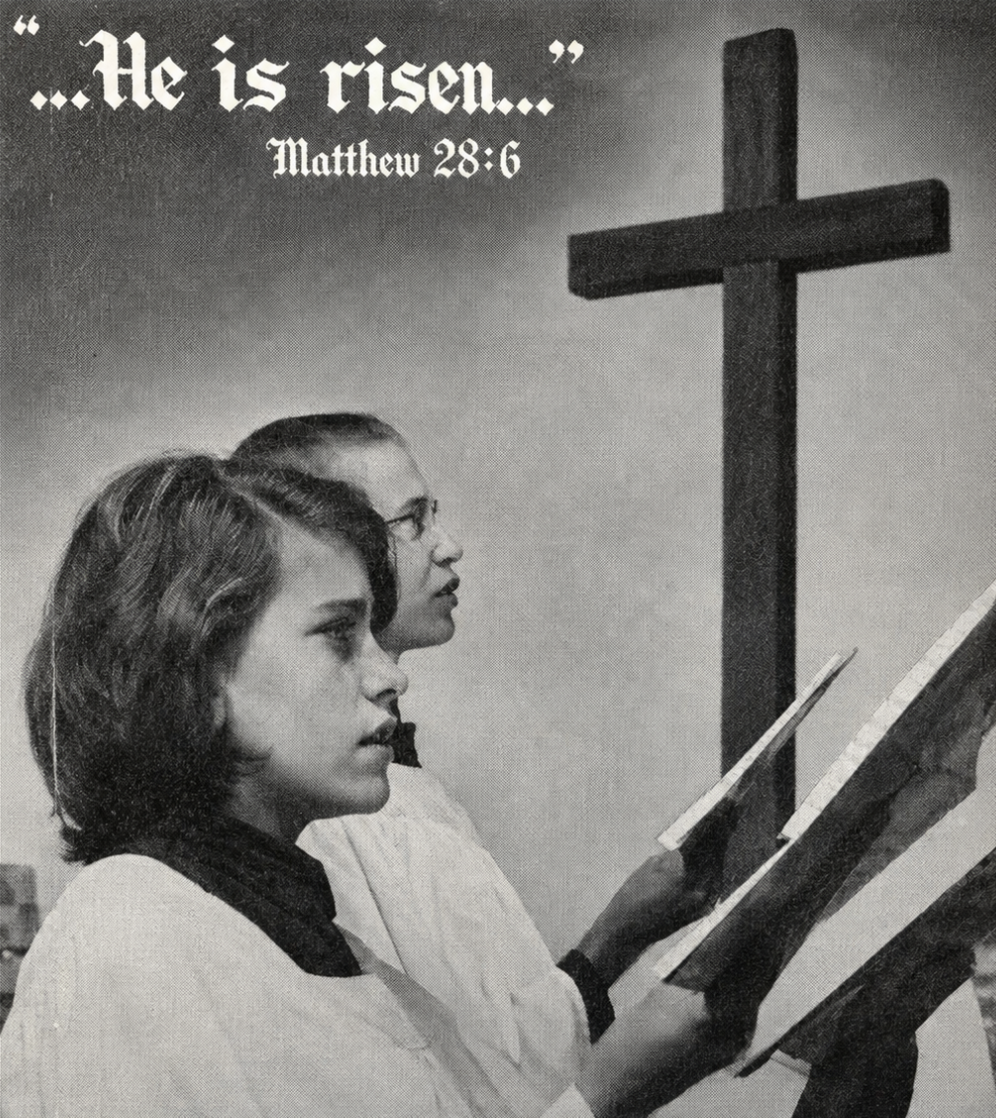
This item appeared on the front page of The Arizona Republic on Easter Sunday, April 18, 1965, with the caption “SING HIS PRAISES!” The solemn responsibility of conveying the Easter message in song is reflected in the faces of Jane Jemsek and Dana Reese, both 12. For Christians everywhere, the Resurrection of Jesus Christ is the promise of Life Eternal.
Two more “daughter churches” sprang from the “mother church” in 1961—Beautiful Savior in Tempe and St. Luke’s in Mesa. Robert Orling once again served as vicar at Mount Calvary during that summer.
In 1962 two more churches began—Lutheran Church of the Master and King of Kings. Then Peace Lutheran opened in 1963, the year Mount Calvary dedicated its new fellowship hall on July 19. Bethlehem Lutheran began in 1964 and called former Wisconsin Synod pastor, Robert Schaller, to its new pulpit. Other “daughters” that would arrive in this decade included St. Mark’s (Phoenix), Eternal Life (Mesa), Epiphany (Chandler), and Trinity (Casa Grande). Mount Calvary encouraged these “offspring” by sending some of its own members (as many as 50 at a time) to worship in these new congregations.
Mount Calvary was again ready to expand physically. On March 14, 1961, a $145,000 project to build a new school and auditorium began with a groundbreaking ceremony. The architect was Richard Nelson.
Pastor Engelbrecht Is Honored
Mount Calvary’s congregation decided in June of 1965 that it would honor Pastor and Mrs. Harold Engelbrecht for ten years of service at Mount Calvary and 45 years in the ministry of the Lutheran Church. Under his administration his flock had increased several hundred percent, had built new facilities and had spun off eleven other church congregations. The thirteen-hundred-member congregation honored its 68-year-old pastor with a world tour that included India, as the Engelbrechts’ son Luther was a missionary there. This gift was presented at a “bon voyage” dinner on June 13, 1965.
Mount Calvary was honoring an illustrious past even as an exciting future was beginning to take form. Former Vicar Robert Orling was the guest speaker on September 6, 1966, at a dinner marking Pastor Engelbrecht’s 69th birthday. Glee was mixed with sadness, however, as Pastor Engelbrecht had announced that he would retire the following month. He felt he could serve the Lord more effectively in the capacity of assistant minister of Zion Lutheran Church in Piedmont, California. Ever the shepherd, Pastor Engelbrecht wrote a moving letter of farewell and encouragement to his flock at Mount Calvary.
Auditorium Is Dedicated
But first, to leave on a high note, he officiated over the dedication of the new Mount Calvary auditorium, unveiled on October 2, 1966, henceforth to be known as Engelbrecht Hall. The pastor of Holy Trinity Lutheran Church in Tucson, Reverend Leland Larson, was guest speaker. A newsletter publicly thanked all the volunteers who had helped to build it, including Architect Richard Nelson and Foreman Barney Schler, along with block layers Loyd Deffner and Harry Lundberg, electrician Joe Ansick and many other members—Walter Haake, Henry Haack, Mr. and Mrs. Nestler, Robert Hosner, Earl Heldt, Bernard Shreckengost, Herman Kleinfeldt and Wilbur Krebs.
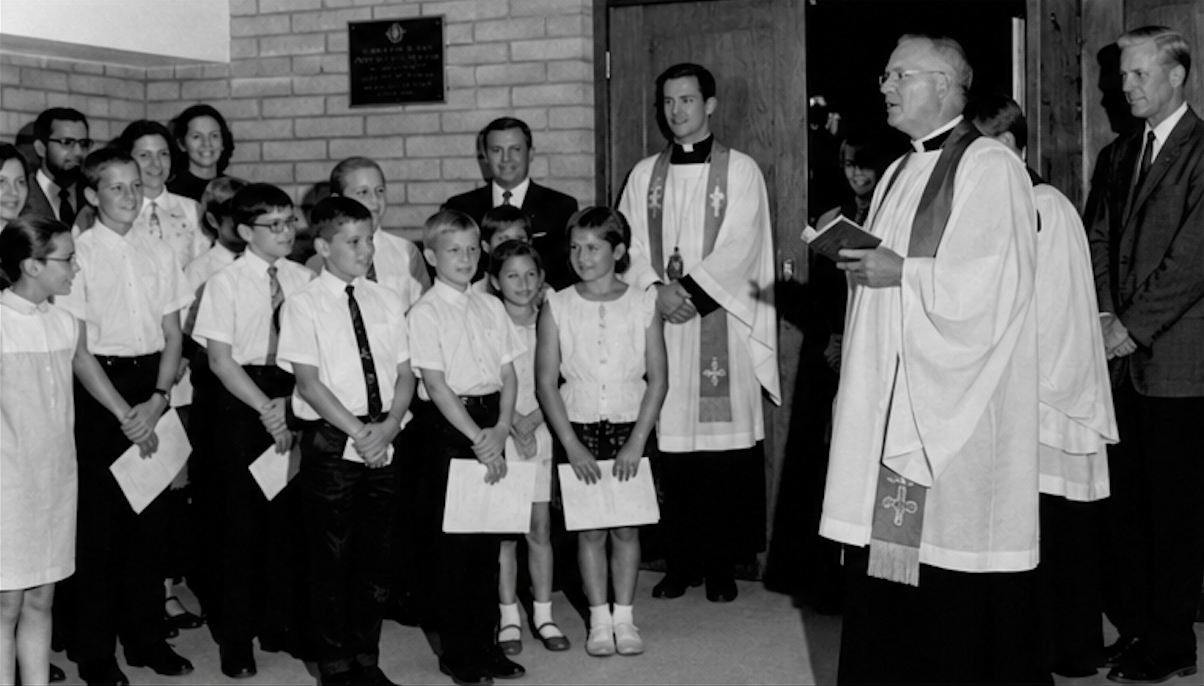
The 5-year program to build the school and auditorium culminated on October 2, 1966, with the dedication of these facilities.
A New Generation Takes Charge
With his official resignation on October 3, Pastor Engelbrecht made room for a younger generation to join the ranks of leadership. The congregation called a 37-year-old pastor to become the next shepherd of Mount Calvary. Reverend Eugene Beyer was installed on March 19, 1967. See Chapter Ten for Pastor Beyer’s biography.
In 1967 August Stellhorn was hired as teacher and principal of the Mount Calvary Day School and organist and director of the church.
In April 1968 the Southern California District held its first convention ever outside of California. Mount Calvary hosted it at the Del Webb Townhouse. A thousand delegates from 216 churches attended.
Emphasis on the value of youthful leadership combining with the older generation culminated in the appointment of David L. Freiberg as Director of Youth and Education on September 21, 1968. The congregation closed out the year by adopting a new constitution and by-laws.
The State of the World
1969: an amazing year of sweeping changes in the world. Richard Nixon, whose loss in 1960 sparked a decade of “New Frontier” liberal Democratic politics, civil rights, space exploration, the Peace Corps, balanced with Cold War tension, a de facto military defeat and rumors of scandal, had now won the election for President of a nation ready to try more conservative politics. For the rest of the millennium (31 years) all successful candidates for President would be conservative or, at most, “middle-of-the-road.” It was a year of disappointment and degradation for some—Dr. Timothy Leary encouraged LSD; four bright young singers from Liverpool, England, praised five years earlier by Ed Sullivan as decent and admirable role models, had turned to drugs and were about to split up; acid rock replaced rock-and-roll in the year of Woodstock. A TV show that had prophesied a wonderful future, promising that a united mankind would “boldly go where no man had gone before” into the “final frontier,” was cancelled for lack of viewership; and yet Neil Armstrong and Buzz Aldrin really did boldly go to the moon this same year. Medical breakthroughs were increasing our life-spans significantly as neglect and disrespect for the elderly increased. Peace talks were beginning to thaw out the Cold War as new countries began to develop their own nuclear weapons. Two songs of the era advocated conflicting prophecies—“Eve of Destruction” and “Dawn of Correction.”
More Change Comes
No one illustrated this historical fork in the road better than Mount Calvary in 1968. Our day school was forced to close due to lack of enrollment. Principal Stellhorn, Teacher Carol Reas (now Mrs. Guy Riddle) and 39 students transferred to Christ Lutheran School. However, in November of 1969 the congregation voted for women’s suffrage, giving the women of the congregation the right to vote and hold offices. God was taking us together into the 1970s—a decade of challenge, a decade of faith.
—Richard Culwell